Ever since I heard of their fights, I’ve been fascinated by giraffes. If you haven’t ever watched a giraffe fight, look it up online. They wack each other to death with their necks. Just watching it makes my neck sore.
Anyways, today’s post is based on the recently published “Seeing spots: quantifying mother-offspring similarity and assessing fitness consequences of coat pattern traits in a wild population of giraffes (Giraffa camelopardalis)” by Lee et al.
So before I explain how these calves (baby giraffes) got their spots from their mamas, let’s get a quick genetics lesson. Gregor Mendel was a monk who performed some very early genetics experiments using pea plants. Mendel would breed two pea plants and see what traits the offspring inherited. He specifically looked at height (tall or short), color (green or yellow), and coat (smooth or wrinkled). Based on these results, Mendel determined a inheritance theory that we still use today. Basically, we inherit traits from our parents.
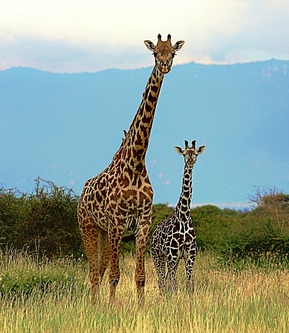
Now, back to the giraffes. The spots on the giraffes can vary in color, size, shape, and smoothness of the perimeter. There are many hypotheses that are unproven as to why their is variation in spots. Some hypotheses include: temperature regulation, recognizing individuals or kin since giraffes are a social species, and camouflage for protection. Again, none of these hypotheses have been proven. In this paper, the scientists were interested to see if there was a pattern to spots, if they were inherited, and if they helped survival. To do this, researchers took pictures of mom and baby giraffe spots. They then used software to extract and quantify patterns, analyze spot traits and similarity between mom and offspring spots, and finally analyzed survival rates in relation to spot patterns.
The scientists in this article found that spot patterns on the coats of giraffes were inherited from the mother. In addition, spot size and shape could predict survival, but they were not able to prove it was because of camouflage, and they hypothesized that it could be related to other survival factors in early stages of life. Offspring with large circular or irregular spots were more likely to have higher survival rates, while offspring with small and medium circular or smaller irregular spots had the lowest survival rates. The scientists contributed this to being an adaptive trait for their surroundings. These findings are important as more research is performed on genetics and adaptive value of mammal coat patterns. Also, the research can help forming a new phylogeny, or trees that connect how species differentiate into new species.
Just like humans, even giraffes look a little like their moms. Thanks for reading!
References
(2018) Seeing spots: quantifying mother-offspring similarity and assessing fitness consequences of coat pattern traits in a wild population of giraffes (Giraffa camelopardalis) PeerJ 6:e5690
 Perpetual Science